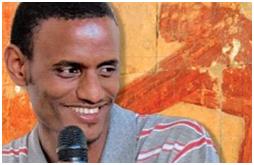
 “In Ethiopia, It is Worse Than in Libya” – Hunde Dhugassa, Ex-Pres. of Students’ Unions
“The right to your own identity and the spirit of solidarity with others are core values. These are two principles that deserve respect,” Hunde Dhugassa
Hunde Dhugassa came to Belgium from Ethiopia in 2007, without his girlfriend, whom he met just four months before he fled. Hunde i
s one of the faces of the campaign byVluchtelingenwerk Vlaanderen entitled “The makeover of life, Uninvited yet succeeded.” He was the elected leader of a student movement in his native country, but his activities were not appreciated by the regime. “Before I graduated from university, I had tens of thousands student followers,” he says. “Only when I graduated, the real problems started. In Ethiopia, it is worse than in Libya. People are arbitrarily imprisoned, tortured and disappeared.”
As a lawyer, Hunde puts justice at high priority. “And that is lacking in my homeland. Ethiopia is supposedly a democracy since the communist dictator Mengistu was ousted in 1991. In the last parliamentary elections, the ruling party won 99.6% of the seats. The resu
lt speaks a lot by itself. Yet, the government is actively supported by the West. The U.S. ambassador shared the joy of praise for the regime for the excellent election campaign.”
Not just politic
s, Western companies also bake cakes with the government led by Prime Minister Meles Zenawi. “Farmers are expropriated of their land and sold to Western companies, putting the former owners at daily laborers status. This is all done without any significant compensation. Ethiopia is rich in resources, but the country is literally sold to businesses while the locals are still hungry. Meanwhile, elites and the few political circles are swimming in luxury.”
Student Movem
ents Potential Threat to Regime
It is against the abuses that students often rebel. “In the capital Addis Ababa and elsewhere in universities, students come together from all over the country, and of all races and tribes. Those people talk to each other, discuss and exchange information. That’s always been a potential threat to the regime. Student movements are treated with suspicion.”
When I was a student
at Jimma University, the power of numbers worked. “We had democratic elections held among students, and I was elected as their chairman. Thus, I had a large constituency, and the government dared not to openly attack me. I got some freedom to criticize government policies and bring up local matters, including issues of student housing and investment in education in particular, and famine and other political issues in general. As a lawy
er, I wanted to strive for greater equity in the Ethiopian society. You know, Ethiopia is indeed a democracy on paper. We have a constitution that can be an example for many other countries on human rights. The right of every citizen is guaranteed. However, that is all on paper – it simply doesn’t apply in practice.”
North Africa and Middle East Signs of Hope
A dictatorial regime is backed by the West for the guise of stability. It has got similarities with the issue of North Africa. “In Ethiopia it is much worse. People are put in prison, tortured or disappeared. To giv
e you an idea, Ethiopians flee to anywhere – even to Libya, just before the war – because Libya has been much better than their own country. The revolutions in North Africa and the Middle East have inspired us and have given us a little hope. Be sure that the political leaders in Ethiopia are watching what is happening i
n countries like Tunisia, Egypt or Libya with frightened eyes. So are our people – apparently, for a democratic revolution.”
Hunde’s problems seriously started after he had graduated [from the Jimma University’s School of Law]. “Some of my fellow students were themselves political activists. Others, like me, wanted to work as lawyers for the fair application of the law in Ethiopia. But, I gradually saw as the threat against me by the government increased. Friends of mine had disappeared, and some ended up in ja
il. I had already got a message that it was my turn soon. Eventually, the threat was too much for me and I left, with pain in the heart. I had to leave everything and everyone behind, including my girlfriend, whom I have come to know just four months earlier. That was all a terrible decision, but it was not my choice.”
Culture Shock
Hunde also got into a real culture shock when he came to Belgium in 2007. “I came here during winter. It was cold and dark. At the refugee center,
there was a very threatening atmosphere. Sometimes, I could communicate just with gestures. You are absolutely in an uncertain environment. There was too much arbitrariness in decision making. People may or may not be granted refugee status, so it remains very unclear what criteria apply in each case. But, even today, I still find some behaviors of Belgians quite strange. Here you can find yourself seating on the train in front of someone for two hours without exchanging a word with each other. In Ethio
pia, this is unthinkable. Finally, I have to admit also that Belgium is actually a nice country. People here have a great sense of justice. How I had felt unsafe at the refugee center has changed now; I feel safe in this country. That feeling is priceless.”
European Law
Meanwhile, Hunde has also completed his university degree in Belgium. In Ghent University, he has studied European law. “I have learned a lot from it. African countries have a lot to learn from European integrati
on. We should see how things are handled with justice, and how the rule of law governs. This is what we, in Africa, especially in Ethiopia, are missing. We have resources, a young pop
ulation willing to build its future, but we lack political leaders who want to help their country move forward instead of themselves. Unfortunately, Europe also uses a double logic. In Africa, it supports leaders who continually and brutally violate human rights, the same rights that they respect for their own people and the same rights that hold paramount importance of their value.”
Hunde, as a lawye
r, follows with great interest the political agony that Belgium finds itself in. “It may surprise you, but the whole contrast between Dutch and French speakers is familiar to me. We have more or less the same history. Ethiopia is a very diverse country
with dozens of groups and different languages. Even if Oromia is the most populous and resourceful area, Oromos remain marginalized for the last one hundred years. But, the resistance has started and has grown to opposition, some of them are armed, for their right to language, culture and for the overall implementation of self-determination. But, at the same time, the Oromo quest for justice and freedom has been regarded as separatist. Though I don’t count myself so radical, I find it difficult discuss
ing issue around this. The right to your own identity and the spirit of solidarity with others are core values. These are two principles that deserve respect. I have no ready-made solution. Wha
t I really like is the debate to continue however difficult it might be. The country continues to remain fully the case. Here, people can still safeguard their rights, respect the law and respect each other despite the political deadlock. I wish this had been possible in Ethiopia.”
Translated from:
The situation in Ethiopian is much worse than in Libya:
Share this:https://www.gofundme.com/8bds2wgk

 QEERROO